
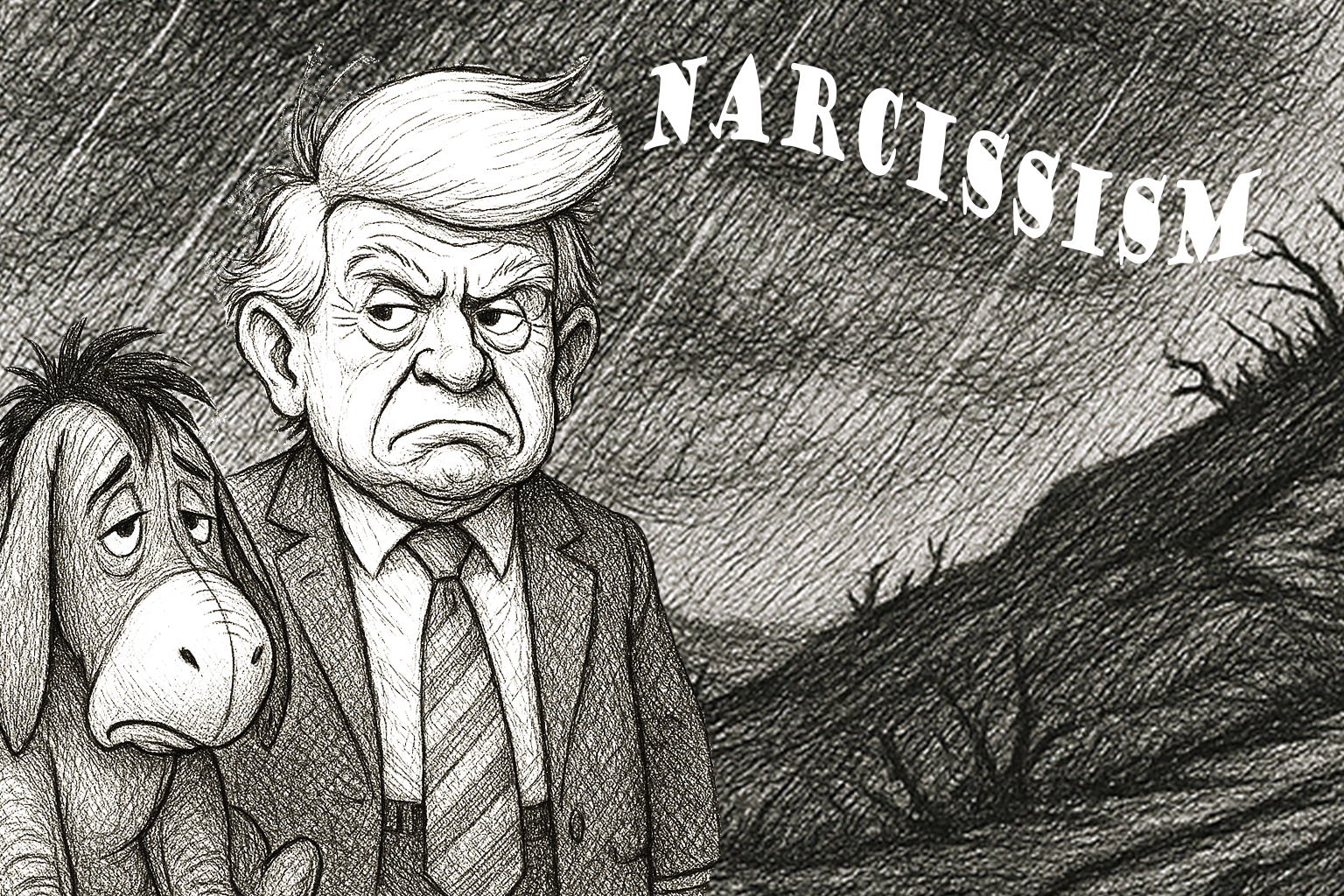
Given that you’re living thought this timeline, you are probably familiar with what a narcissist, specifically, a malignant narcissist.
For Trump, all exists as an extension of himself; other people exist insofar as they are opportunities to be taken advantage of. His children are extensions of himself;[1] likewise, all who are fortunate enough to be allowed access to him thereby become extensions of himself which only exist to serve him: betrayal is not perfectly reflecting to him the reality he asserts.[2]
When you add to this disordered personality, an enjoyment of cruelty, you get sociopathy.[3] At the risk of digressing, MAGA as a whole, is itself an expression of sociopathy as culture.[4] In this sense, most people understand, or are beginning to grasp, how and why narcissism is so toxic to everything and everyone in this moment.
However, there is a type of narcissism that is every bit as toxic as Trump-type narcissism, and every bit grandiose in its assertion of distorted reality. It’s just that this type is narcissism is very good at manipulating those who encounter it because the narcissist is clearly suffering. Whereas Trump will perform pomposity rather than competency, this sort of narcissist will perform anguish rather than competency.
Eeyore’s Narcissism
Both narcissists use fear to control the world around them. For the Trumps of the world, it is his outer-directed wrath all must fear; for the Eeyores of the world, it is his inner-directed wrath all must fear. While the Trumps of the world (especially those slipping into sociopathy) might take pride in the ways they wield the specter of harming others to manipulate and compel control, the Eeyores of the world will wield the specter of harming themselves to manipulate and compel control. Both will express offense at having this predatory behavior identified.[5]
Both of these narcissists have an inner life defined by a stream of consciousness focused upon themselves, their grudges, their wants, and their resentments. Both know that if the would just behave in the way they want, all would be well. And if not well, at least tolerable. Those not acting in ways that please them are, in the narcissist’s warped understanding of life, acting against them.[6]
Problematically for those most aware of the Trump narcissist type, the Eeyore narcissist type is Neo from the Matrix, when it comes to bobbing and weaving around taking responsibility for their actions. If you call out an Eeyore narcissist type, rather that reacting with outer-directed wrath, the wrath is inwardly directed: “You’re right,” says Eeyore. “I am a fuck up. I turn everything I touch to shit. The world would be better without me.”
Here, Eeyore’s performance is every bit as manipulative, self-serving, and self-centered as a Trump-type’s outer-wrath might be. While the Trump-type uses the implicit and explicit threat of harming another to manipulate and control others, the Eeyore-type uses the implicit and explicit threat of harming themselves to manipulate and control others. For both, the message is the same: Please me or else.
Epistemological Responsibility
All narcissists have an undeveloped capacity for accountability, evidence-based belief structures, healthy reflection to criticism, and open-mindedness. Strangely, I’ve noticed that both the Trump-type and Eeyore-type narcissist can identify these undeveloped capacities in the other narcissist type, but not their own. Both an Eeyore and Trump-type narcissist will express a particular reaction when they encounter each other: disgust. It is as if each type has banked the critiques they’ve encountered of their own toxic behavior to only will express, fire hose-style revulsion at the other’s underdeveloped capacity to critically reflect upon the belief structures which define they other’s narcissism.
Trump vs Eeyore Narcissism
| Core Trait | Trump-type Narcissism | Eeyore-type Narcissism | General Narcissism |
| Sense of Self | Inflated, superior, dominant | Insecure, self-pitying, resentful | Self-centered and self-important |
| External Presentation | Arrogant, boastful, aggressive | Depressive, anxious, self-effacing | Manipulative, demanding |
| Manipulation Strategy | Threatens others, blames/shames, dominates | Threatens self-harm, elicits pity/guilt | Self-serving coercion |
| Reaction to Criticism | Rage, defensiveness, externalizes blame | Shame, withdrawal, self-denigration | Inability to accept critique |
| Empathy Level | Low empathy, uses others | Low empathy, preoccupied with own suffering | Lack of genuine empathy |
| Control Mechanism | Fear via aggression or punishment | Fear via self-destruction or emotional collapse | Control others for self-validation |
| Common Emotional Tone | Anger, arrogance, triumphalism | Sadness, victimhood, guilt-tripping | Egocentric emotional reactivity |
| Risk of Harm to Others | High: through verbal or emotional abuse | Moderate: indirect guilt-based coercion | Toxic to others |
| Risk of Self-Harm | Low; rarely threatens or enacts self-harm | High: may use suicidal ideation/manipulation | Toxic to self and others |
| Accountability | Rejects responsibility; externalizes flaws | Rejects responsibility; deflects with despair | Lacks insight and openness |
| Relationship Style | Demanding admiration, punishes dissent | Clings to caretakers; manipulates through need | Exploitative and emotionally unstable |
| Cultural/Political Expression | Cult of personality; authoritarianism; egotism | Moral martyrdom; grievance politics | Can manifest in group or ideological identity |
References
Briscoe, J. (2021, August). Not all narcissists are grandiose – the “vulnerable” type can be just as dangerous. Retrieved from the Guardian: https://www.theguardian.com/lifeandstyle/2021/aug/01/not-all-narcissists-are-grandiose-the-vulnerable-type-can-be-just-as-dangerous
Estlein, R., Gewirtz-Meydan, A., & Finzi-Dottan, R. (2024). Maternal narcissism and child maladjustment: a dyadic study. Current Psychology, 34705-34716.
Fatfouta, R., & Rogoza, R. (2024). Playing the victim? Facets of narcissism, self-perceived victimhood, and the mediating role of negative affect. Advances in Cognitive Psychology, 92-97.
O’Reilly, C., & Hall, N. (2021). Grandiose narcissists and decision making: Impulsive, overconfident, and skeptical of experts–but seldom in doubt. Personality and Individual Differences, 168:110280. https://doi.org/10.1016/j.paid.2020.110280
Xanya, S. (2020). The Dark Reflection of Sadism within the Brilliance of the Narcissistic Persona. Health, 1279-1298. https://doi.org/10.4236/health.2020.129092
[1] “Narcissistic parents often display behaviors that can greatly impact their children’s emotional and psychological development. Such parents tend to be overly possessive and view their children as extensions of themselves. Within this dynamic, the child is perceived as existing solely to fulfill the parent’s needs and wishes.“ (Estlein, Gewirtz-Meydan, & Finzi-Dottan, 2024)
[2] “A substantial body of research has documented that grandiose narcissists are characterized by high self-esteem, a sense of personal superiority and entitlement, overconfidence, a willingness to exploit others for self-gain, and hostility and aggression when challenged. We report two studies (N = 452) that explore how these dispositions affect their decision making. We show that grandiose narcissists’ overconfidence, impulsivity, and a willingness to ignore expert advice results in a higher likelihood of making a bad decision. In addition, after getting the wrong answer, grandiose narcissists are more likely to blame others and remain self-confident in their judgment.” (O’Reilly & Hall, 2021)
[3] “… hypersensitive to criticism, and driven by the attachment of idealization or the repulsion of devaluation. According to Kernberg, sadism is inherent in the psychodynamics of malignant narcissism that serves as the bridge connecting antisocial and narcissistic character dimensions. The malignant narcissist’s antisocial behaviour is inflamed by ego-syntonic aggression and sadism. Lashing out their aggression confirms their superiority and feeds their grandiosity. This seemingly purposeless venting of aggression is contrasted by the antisocial personality’s repertoire, that reflects predominantly parasitic and manipulative behaviours targeting material self-gain.” (Xanya, 2020)
[4] “Both experimental narcissistic groups evidenced more prevalent psychopathology, yet, higher achievement, efficacy and ambition than their reciprocal control groups, confirming the narcissists’ finesse in concealing psychopathology under the brilliance of their pseudosuperiority. The main danger is the affinity between masochism and sadism, bonding low and high functioning narcissistic counterparts to endlessly feed from each-others’ pathology, forming dysfunctional interpersonal relationships, cults or disintegrating societies. This sadomasochistic dependency also reflects several countries’ authoritarian trends, where narcissistic constituents’ unyielding loyalty elevates idolized leaders to power, preluding the establishment of toxic tyrannical governments.” (Xanya, 2020)
[5] “A sense of victimhood appears to be primary, in which the narcissist will persecute from the victim position, often denigrating themselves and thereby fishing for reassurance.” (Briscoe, 2021)
[6] “The current study illustrates the value of assessing both agentic and antagonistic facets of narcissism in research investigating the role of narcissism in perceptions of victimhood. We demonstrated that the narcissism-victimhood association is differentially mediated by negative affect.” (Fatfouta & Rogoza, 2024)
















Leave a Reply
You must be logged in to post a comment.